
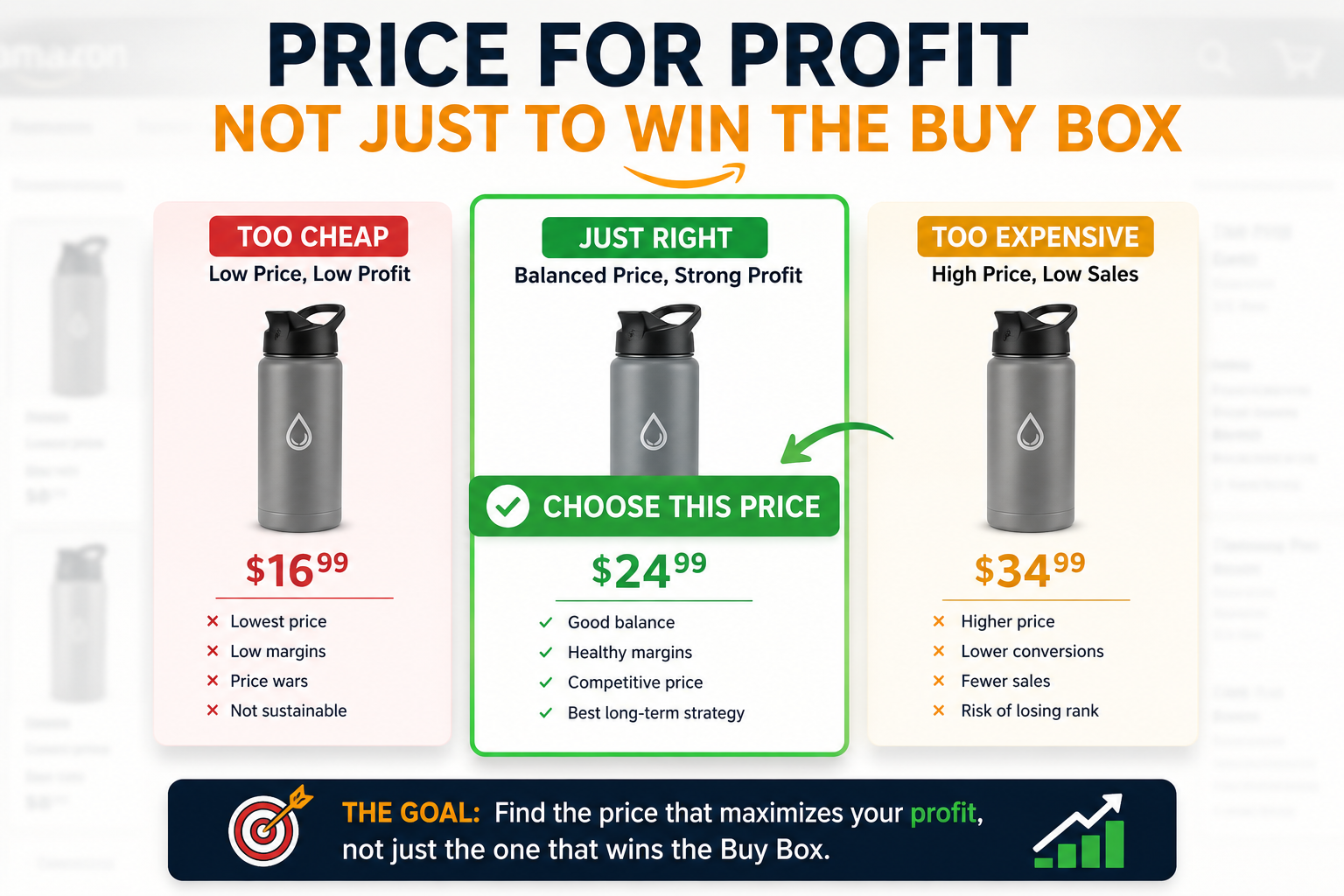
How to Price for Profit on Amazon
Many Amazon sellers spend hours trying to win the Buy Box and almost no time determining whether the price they are competing at actually makes sense.
It is easy to understand why. The Buy Box is visible. Sales are visible. Revenue feels like progress.
Profit is quieter.
That is where pricing gets dangerous. A product can win sales, move inventory, and still leave very little money behind after Amazon fees, advertising costs, shipping, returns, and inventory expenses are included.
Pricing is not just a sales decision. It is a profit decision.
Why Most Sellers Think About Pricing Wrong
When a listing starts losing momentum, the first instinct is usually to lower the price.
Sometimes that is the right move. If the product is new, reviews are limited, or inventory needs to move, a temporary price adjustment can make sense.
But price cuts become a problem when they turn into the default strategy.
Every dollar removed from your selling price reduces the amount available to cover advertising, fulfillment, storage, returns, and future growth. Lower prices may increase order volume, but they can also create a business that needs more sales just to produce the same profit.
That is why pricing should start with margin, not panic.
Revenue and Profit Are Not the Same Thing
A common mistake is assuming that the product with the most revenue is automatically the best product.
That is not always true.
A cheaper product may generate more sales and still produce weaker profit than a higher-priced competitor with fewer orders. The difference comes down to cost structure, margins, and how much money is left after the sale.
The point is not that one price is always better than another. The point is that revenue alone does not tell you enough.
A strong pricing strategy looks at what the product earns, not just what it sells.
Understand Your True Cost Structure First
Before choosing a price, you need to know what it actually costs to sell the product.
Your supplier cost is only the beginning. Amazon sellers also need to account for referral fees, FBA fees, freight, storage, returns, advertising, discounts, and the occasional unexpected cost that shows up once a product is live.
This is why pricing and profitability should be handled together. A product with strong demand can still become a poor opportunity if the numbers are too tight.
Related Topics
- What Makes a Product Profitable on Amazon?
- How to Calculate Your Real Amazon Profit: Fees, Advertising, and Hidden Costs
The Cheapest Seller Does Not Always Win
Amazon is competitive, but it is not always a simple race to the lowest price.
If price were the only factor, every category would eventually collapse into the cheapest possible version of the product. That is not what happens.
Customers still respond to reviews, images, titles, delivery speed, brand trust, and perceived quality. A product with better positioning can often hold a stronger price than a cheaper alternative.
This matters because the best pricing opportunity is not always found by undercutting competitors. Sometimes it is found by building a product and listing that can justify a better price.
That is where pricing connects directly to listing quality. A product page that explains value well can support stronger margins than a listing that gives shoppers no reason to choose it beyond price. The guide What Makes a Good Amazon Product Listing? is useful here because a stronger listing often gives sellers more pricing flexibility.
Study Competitor Pricing Without Copying It
Competitor pricing is useful, but not because it tells you exactly what to charge.
It gives you context.
When reviewing a market, look for pricing clusters. Are most products sitting between $19.99 and $24.99? Is there a clear premium tier above $30? Are sellers using coupons instead of changing the base price? Are prices stable, or do they shift every few days?
These patterns tell you how the market behaves.
A competitor charging more than everyone else may be overpriced. Or they may have stronger reviews, better branding, a bundle, or a feature that makes the higher price believable.
The goal is not to copy their number. The goal is to understand why that number may be working.
Related Topics
- How Do I Analyze My Competitors' Products and Pricing Strategies?
- What Is BSR and How to Use It for Product Research?
- How to Tell If an Amazon Niche Is Too Saturated
How Pricing Affects the Buy Box
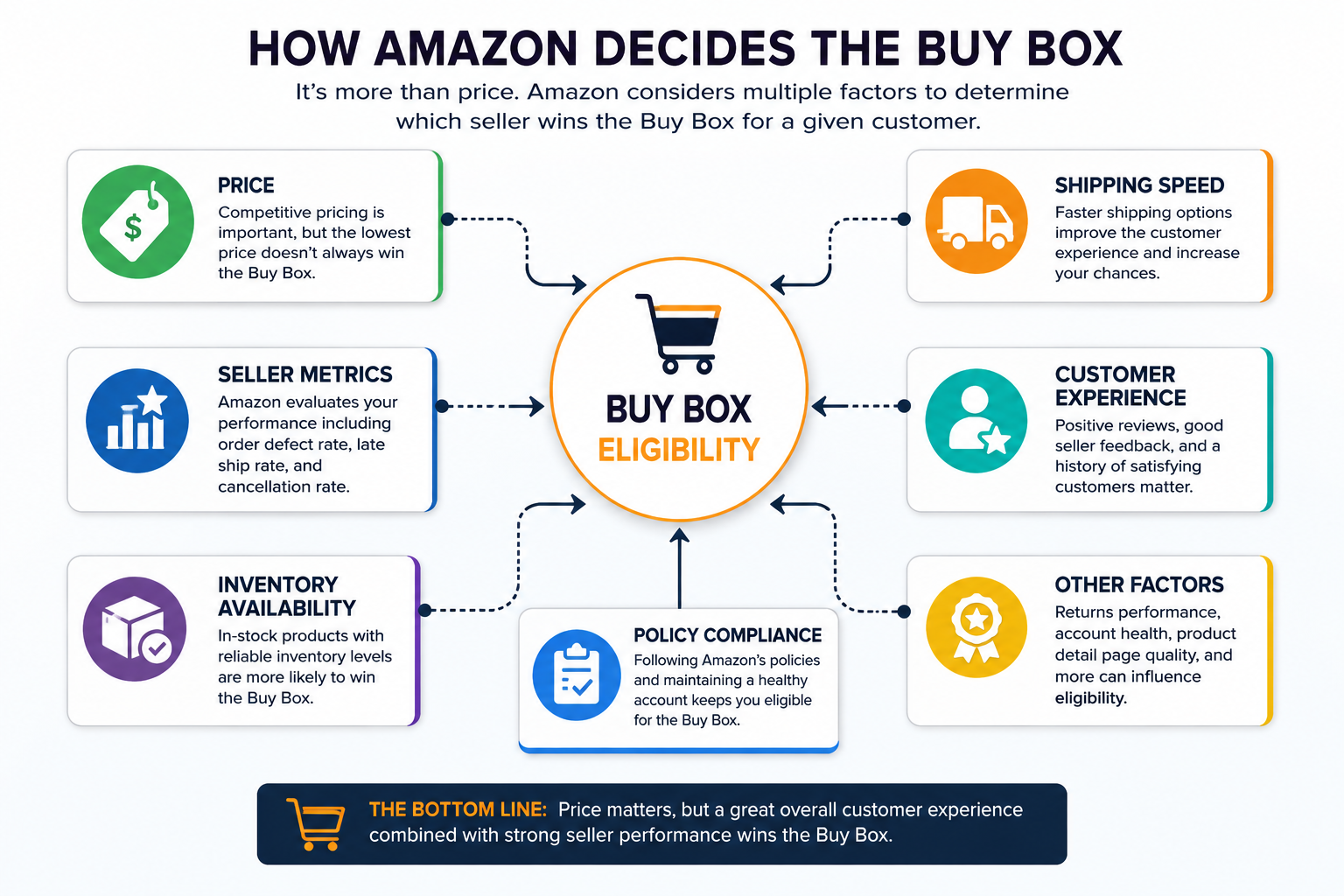
The Buy Box matters because it is where most Amazon sales happen. But winning it is not only about being the cheapest seller.
Amazon considers multiple factors, including price, fulfillment method, seller performance, delivery speed, inventory availability, and customer experience.
This is why one seller may win the Buy Box even when another seller is slightly cheaper.
That does not mean price is unimportant. It means price is part of a larger system.
A better question than “How low do I need to go?” is:
What is the highest price I can sustainably charge while still remaining competitive?
That shift changes the entire strategy. Instead of treating pricing as a race downward, you treat it as a balance between competitiveness and margin protection.
The foundation for this is explained in A Beginner’s Guide to Understanding Amazon’s Buy Box Algorithm, which is helpful context before making aggressive pricing changes.
The Danger of Race-to-the-Bottom Pricing
At some point, most sellers run into a competitor willing to cut prices aggressively.
It can feel like you have no choice but to follow.
Sometimes you do need to respond. But constant price matching can create a race to the bottom that weakens everyone in the category.
The danger is not just lower profit per sale. It is the loss of flexibility.
When margins are thin, you have less room to advertise, less room to absorb returns, less room to restock aggressively, and less room to survive mistakes.
A business built entirely on being cheap is fragile.
Repricing Tools Are Only as Smart as Their Rules
Repricing tools can be useful, especially in competitive markets where prices change often.
The issue is not automation itself. The issue is automation without profit boundaries.
A repricer that blindly undercuts competitors may help win more sales while quietly damaging margins. A better repricing strategy protects a minimum profitable price and only competes within a range that makes sense for the business.
In other words, the repricer should support your strategy, not replace it.
Related Topics
- The Smart Seller’s Guide to Repricing: Winning the Buy Box Without Losing Profit
- Rule-Based vs Algorithmic Repricing on Amazon
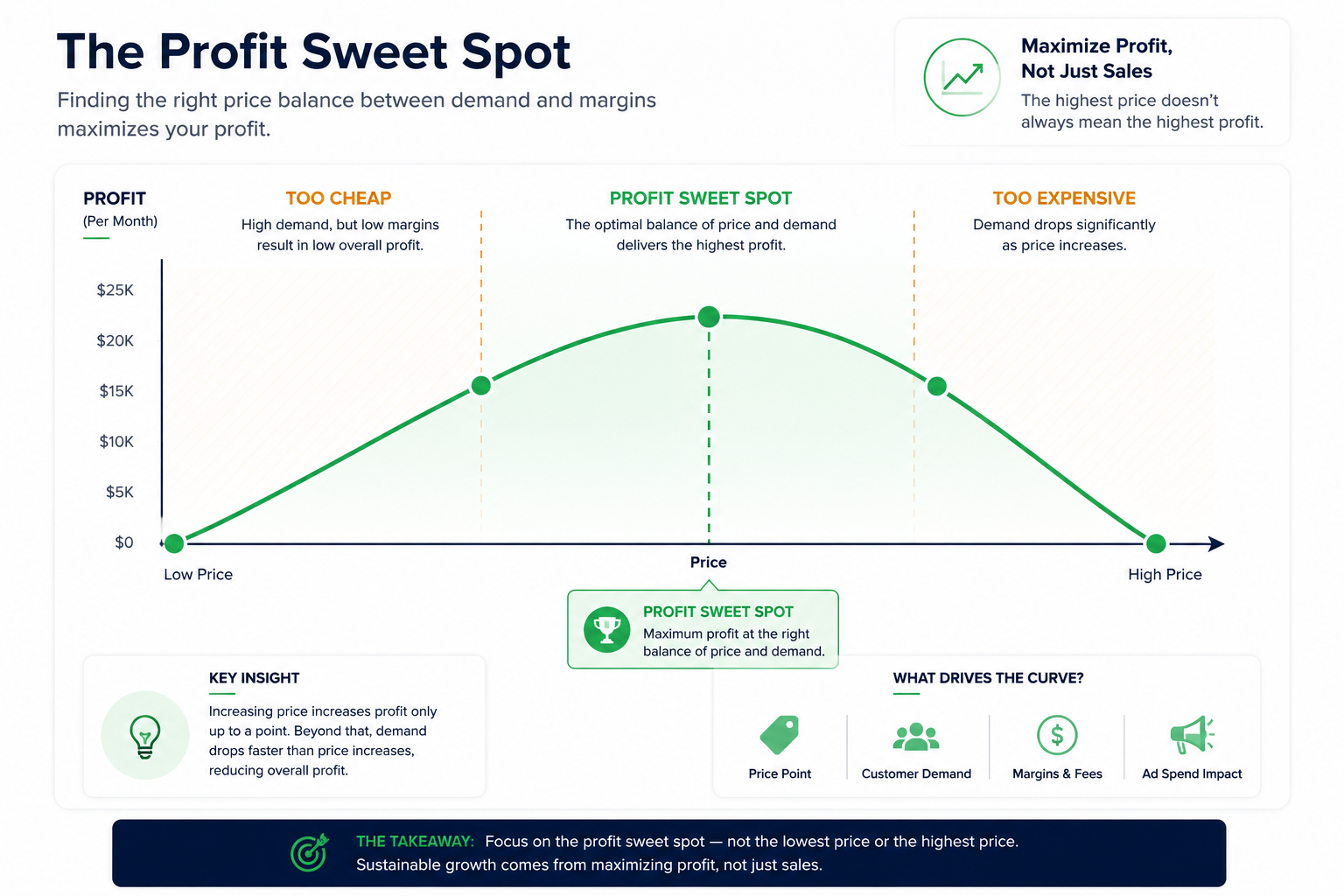
Finding Your Profit Sweet Spot
The ideal price is rarely the absolute highest or lowest option available.
It usually lives in the middle.
Too low, and profit disappears. Too high, and demand slows down. Somewhere between those two points is a pricing range where demand remains healthy and margin remains attractive.
That range is your profit sweet spot.
When It Makes Sense to Lower Prices
Lowering price is not always bad. It just needs to be intentional.
There are legitimate reasons to become more aggressive with pricing, especially during a launch, when clearing slow-moving inventory, when responding to short-term competitive pressure, or when trying to increase early conversion velocity.
The key is knowing whether the discount is temporary or permanent.
A strategic discount is a tool. A permanent margin sacrifice is a problem.
When Raising Prices Makes Sense
Many sellers are comfortable lowering prices but hesitant to raise them.
That hesitation can leave money on the table.
Raising prices may make sense when demand is strong, reviews are improving, competitors are out of stock, inventory is limited, or your product has clearly differentiated itself.
Pricing should adapt to market conditions. It should not only move downward.
A Simple Amazon Pricing Checklist
Before changing a product price, ask the following questions.
Price for the Business You Want to Build
Winning the Buy Box matters. Generating sales matters. Staying competitive matters.
But none of those things matter much if profitability disappears.
The strongest Amazon sellers understand that pricing is not only about getting the next order. It is about building a business that can afford advertising, inventory, growth, and competition.
That requires more than being cheap.
It requires knowing your costs, reading the market carefully, understanding your position, and protecting the profit needed to keep moving forward.
That is what pricing for profit looks like.
.png)