
You’ve got a product idea. You run the keywords in a few tools, look at estimated sales, and everything looks promising.
The real question: is there actually room for you, or is this niche already cooked?
You don’t need a massive spreadsheet to get a first answer. With a few quick checks on Amazon itself, you can see whether you’re walking into an opportunity or a war zone.
Quick Red Flags Checklist
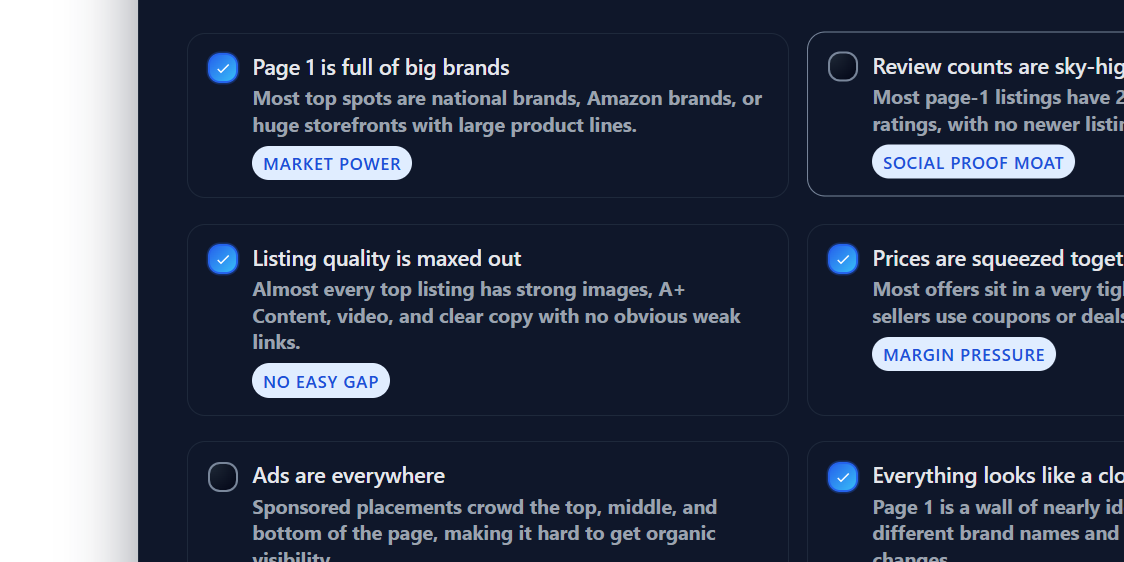
Open Amazon, search your main keyword, and look at page 1. If you say “yes” to most of these, you’re probably in a saturated niche:
- Page 1 is dominated by big brands or Amazon’s own brands
- Most top listings have 2,000+ reviews and 4.5★+ ratings
- Every listing has strong A+ Content, videos, and high-end images
- Prices are very close together and everyone is running coupons or deals
- Sponsored ads are stacked at the top, in the middle, and at the bottom
- You see a wall of nearly identical “me too” products with different brand names
- Reviews don’t show a clear, repeated problem you can actually fix
- There’s no seller with “only” a few hundred reviews doing surprisingly well
If that checklist feels like your keyword… you’re not just late to the party, you’re trying to squeeze onto a packed dance floor.
Let’s break these down.
Red Flag #1: Page 1 Is All Heavyweights
If page 1 is full of:
- National brands you’d recognize off Amazon
- Amazon Basics or other Amazon-owned labels
- Sellers with huge storefronts and dozens of similar products
…you’re competing with teams that have bigger ad budgets, better supplier deals, and established brand trust.
It doesn’t automatically mean “don’t do it,” but it does mean you’ll need strong differentiation and serious capital to make a dent.
Ask yourself:
- Can I realistically look more trustworthy than these brands?
- Can I afford to lose money on PPC for a while to get traction?
If the honest answer is no, move on.
Red Flag #2: Reviews Are Sky-High Across the Board
One of the simplest saturation checks is review counts.
A niche feels very different if page 1 looks like:
- 600 reviews, 1,200 reviews, 3,500 reviews, 900 reviews...
versus:
- 40 reviews, 120 reviews, 300 reviews, 70 reviews...
As a rough guide:
- If most of page 1 is at 2,000+ reviews, you’re walking into a mature battlefield.
- If everyone is above 4.5★, you’re also facing very sticky listings with strong social proof.
What you want to see:
- A few listings with <500 reviews that rank well and clearly generate good sales.
That’s a sign there’s still room for newer entrants to climb.
If the only winners have massive review moats, you’ll spend a long time just trying to look credible.
Red Flag #3: No Gaps in Listing Quality
Experienced sellers often find opportunities by looking for gaps, not just search volume.
A simple approach:
- Look at the top 10 listings.
- Ask:
- Are the photos sharp, lifestyle-based, and clearly show use cases?
- Does almost everyone have A+ Content and a brand story?
- Are titles and bullets clear, benefit-driven, and easy to scan?
If the answer is “yes” across the board, you’ve lost one of the easiest edges: better presentation.
On the other hand, if you see a product that’s clearly selling well (good BSR, lots of reviews) but:
- Has weak photos
- No A+ Content
- Confusing bullets
…that’s actually good news. It means the niche might not be saturated; that seller is just winning on being early, not being excellent.
Red Flag #4: Prices and Coupons Show a Race to the Bottom
Next, scan pricing:
- Are most offers within a very narrow price band (e.g., $18.99–$21.99)?
- Are tons of listings running stacked coupons, lightning deals, or strike-through pricing?
That’s usually a sign of a margin war.
When niches are younger, you often see a wider spread:
- Premium listings with better branding
- Cheaper options with weaker listings
- Some mid-tier offers in between
When everything has collapsed into the same price point plus coupons, you’re looking at a niche where everyone is trying to undercut everyone else just to keep sales moving.
If your differentiation plan doesn’t justify a higher price, you’ll be dragged into that same race.
Red Flag #5: Ads Are Crowded and Expensive
You don’t need to know exact CPC yet to feel how aggressive a niche is.
Look for:
- Multiple Sponsored Products at the very top
- Sponsored Brands banner above everything
- Sponsored placements in the middle and at the bottom of page 1
In a saturated niche, it can feel like there are more ads than organic results.
Why this matters:
- New products depend heavily on PPC to get initial visibility
- If every click costs a lot and conversion is low (because competitors are strong), your blended ACOS quickly becomes unprofitable
If you see heavy ad saturation and all the organic spots are stacked with huge review counts, you’re basically trying to out-spend people who’ve been there for years.
Red Flag #6: Reviews Don’t Reveal a Clear Problem to Solve
One of the smartest “human” checks is to read the reviews, especially the 3★ and 4★ ones:
- Are customers complaining about the same issue over and over?
- (Size, durability, missing feature, confusing instructions?)
- Or are complaints random and all over the place?
If you see a repeated problem you can fix, that’s a potential gap—even in a busy niche.
If reviews mostly say:
- “Great product, works as expected”
- “Love it, no issues”
…and the only complaints are about shipping or one-off defects, then there’s not much room to improve the offer itself. You’d be launching something basically identical and hoping your marketing alone carries you.
When a Crowded Niche Might Still Be Worth It
Sometimes a niche looks crowded but is still worth entering if you bring something new. Examples:
- You genuinely improve the product
- Better materials, clearer instructions, smarter design
- Better materials, clearer instructions, smarter design
- You bundle in a missing element
- Accessories, digital guide, or “kit” version nobody else offers
- Accessories, digital guide, or “kit” version nobody else offers
- You have off-Amazon traffic
- An email list, social following, or brand presence that can drive initial sales
- An email list, social following, or brand presence that can drive initial sales
- You’re going ultra-specific
- Instead of “yoga mat,” you go after a clearly defined sub-niche (e.g., travel-friendly folding mat for commuters)
- Instead of “yoga mat,” you go after a clearly defined sub-niche (e.g., travel-friendly folding mat for commuters)
The key question:
“If I put my product on page 1 next to the current top sellers, would a reasonable shopper have a clear reason to choose mine?”
If that answer is fuzzy, the niche is effectively saturated for you, even if the sales volume is high.
A Simple 10-Minute Saturation Test for Any Niche
Here’s a quick process you can use for every new idea:
- Search your main keyword on Amazon.
- Scan page 1 and jot down:
- How many big brands vs. unknown brands
- Average review count for the top 10
- How many listings lack A+ Content or have weak photos
- Price range and coupon usage
- How “ad-heavy” the page feels
- Read 20–30 reviews across 3–5 top listings:
- Note repeated complaints
- Note anything customers wish the product did
- Score it:
- Lots of red flags, no obvious gap → Walk away
- Mixed signals but clear, fixable complaints → “Maybe” with a strong differentiation plan
- Several weak listings and clear customer pain points → Dig deeper with full product research
This process won’t replace deep keyword and margin analysis, but it will stop you from spending days modeling a niche that was clearly saturated from the first glance.
.png)