
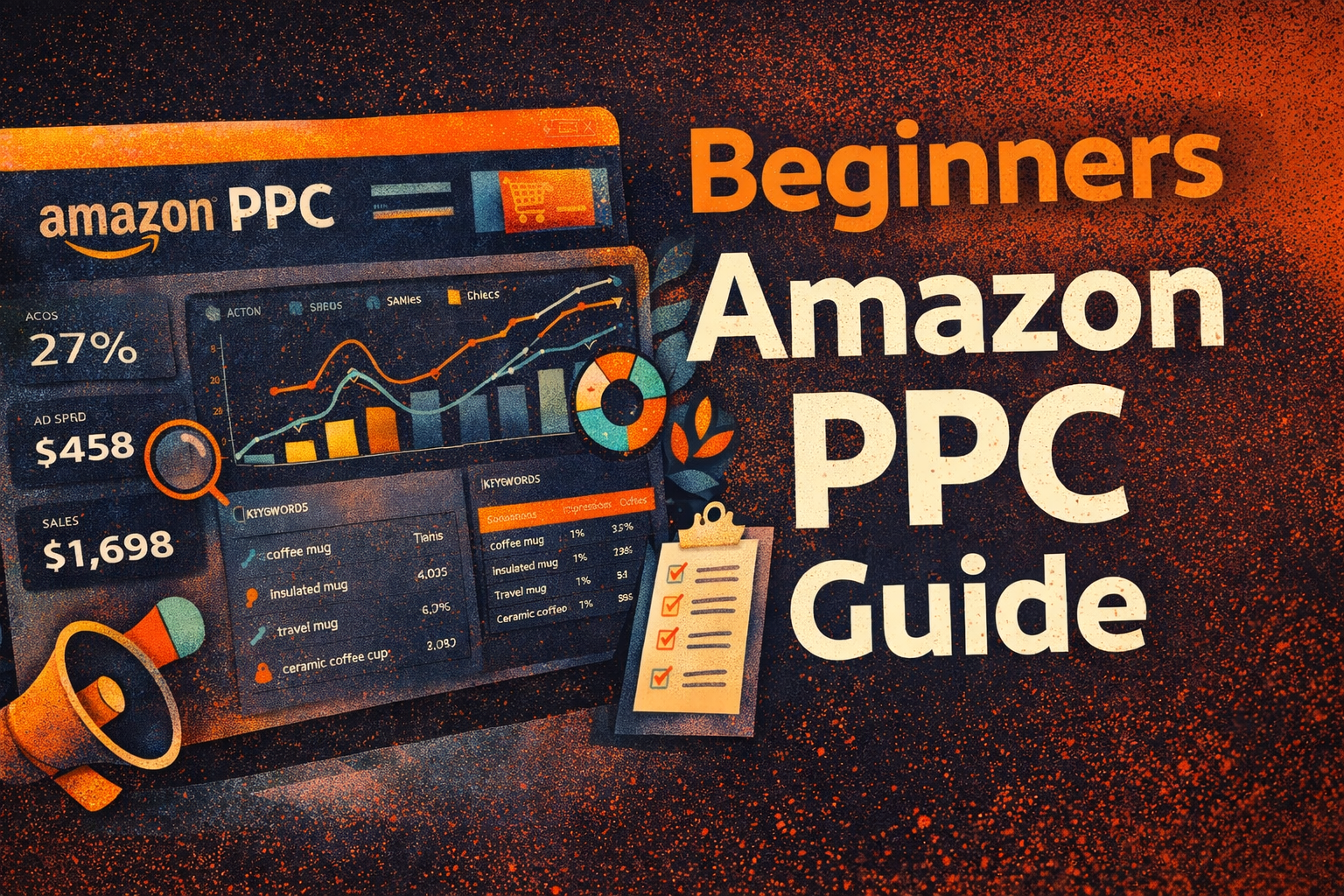
Here’s something that surprises a lot of new sellers.
You can build a great Amazon listing — solid photos, a decent title, competitive price — and still hear… nothing. No sales. No momentum. Just silence.
It’s frustrating. And honestly, it feels a little unfair at first.
Because Amazon isn’t really a passive marketplace anymore. It’s closer to a shopping mall where every storefront has a megaphone, and the ones willing to pay for the loudest one tend to get the attention. That megaphone? Amazon PPC.
PPC stands for pay-per-click advertising, and once you start selling on Amazon you’ll notice it everywhere — those sponsored listings at the top of the search results, the products tucked between organic listings, the ads that follow shoppers around the platform like a polite (but persistent) salesperson.
That’s PPC. And learning how it works is almost a rite of passage for sellers.
What Amazon PPC Actually Is
At the most basic level, Amazon PPC is pretty simple.
You run ads.
Someone clicks the ad.
You pay Amazon a small fee for that click.
That’s it.
But — and this is where things get interesting — those clicks happen inside Amazon search results, which means they reach shoppers who are already in buying mode. Not casually browsing like on social media. Not killing time. These people are typing things like “stainless steel garlic press” or “ergonomic office chair.”
They’re hunting.
And when your product appears as a Sponsored Product, you’ve essentially cut the line.
Why Sellers Use PPC in the First Place
Some people try to avoid PPC entirely.
I get it. Ads feel like spending money before you’re making money. That’s uncomfortable.
But here’s the catch — without advertising, most new listings sit buried somewhere on page six of the search results. And page six on Amazon might as well be the Mariana Trench.
Nobody goes there.
PPC solves a few problems all at once:
- Visibility – your product actually shows up in front of shoppers
- Sales velocity – Amazon’s algorithm sees activity on your listing
- Keyword discovery – you learn what customers are searching for
- Ranking improvement – more sales can eventually boost organic placement
In other words, PPC isn’t just advertising. It’s also data.
And data is gold.
Where Amazon Ads Show Up
Once you notice them, you’ll see these everywhere.
Amazon PPC ads appear in a few common places:
Top of search results
Those sponsored listings sitting above the organic products.
Within search results
Mixed between normal listings — sometimes you don’t even notice the difference.
Product detail pages
Ads for competing products appear directly on someone else’s listing.
Sneaky? Maybe a little. Effective? Very.
It means your product can appear right when a shopper is comparing options, which is often the moment when buying decisions get made.
The Core Pieces of an Amazon PPC Campaign
Running ads on Amazon isn’t wildly complicated, but there are a few moving parts that matter.
Think of PPC campaigns like a small machine with several gears turning at once.
Keywords
Keywords trigger your ads.
If someone searches for “ceramic coffee mug,” Amazon looks for ads targeting that phrase (or something similar). If your campaign includes that keyword, your ad becomes eligible to appear.
Sometimes it wins the spot. Sometimes not. That’s where bids come in.
Bids
Your bid is how much you’re willing to pay for a click.
Not what you actually pay — that’s usually lower — but the maximum you’re offering. Amazon runs a quick auction behind the scenes every time someone searches for something.
Highest bid with a relevant product tends to win.
Simple in theory. Slightly chaotic in practice.
Budget
Your daily budget controls how long your ads run.
If you set a $20 daily budget, Amazon stops showing your ads once you hit that spending limit for the day. Some sellers start small. Others go harder early to gather data faster.
There’s no single right approach here. Depends on the product. Depends on margins. Depends on how aggressive you’re feeling that week.
The Metric Everyone Talks About: ACOS
Sooner or later you’ll hear someone say something like:
“My ACOS is too high.”
ACOS stands for Advertising Cost of Sale. It measures how much you’re spending on ads relative to the revenue they generate.
The formula is straightforward:
Advertising Spend ÷ Ad Sales = ACOS
If you spend $20 on ads and those clicks generate $100 in sales, your ACOS is 20%.
Good or bad? That depends entirely on your profit margin.
Some sellers panic when they see high ACOS numbers early on. But during product launches — especially when you’re gathering keyword data — slightly messy numbers are pretty normal. Even expected.
Automatic vs Manual Campaigns
Amazon PPC campaigns usually fall into two categories.
Automatic campaigns
Amazon decides which search terms trigger your ads.
These are great for beginners because Amazon essentially explores the marketplace for you, testing different keywords and discovering what customers respond to.
Manual campaigns
You choose the exact keywords yourself.
Manual campaigns give you control — which means they’re often used once you know which keywords actually convert. Many sellers run both types side by side.
Automatic campaigns gather intelligence.
Manual campaigns apply it.
Why PPC Matters Even If You Hate Ads
Let’s be honest.
Most sellers don’t love running ads. It can feel fiddly, a little confusing, and occasionally like feeding dollar bills into a vending machine that refuses to dispense snacks.
But PPC does something important — it jumpstarts visibility.
Without it, new listings often struggle to generate the initial sales Amazon’s ranking algorithm needs to trust the product. Ads help break that stalemate.
They also reveal something incredibly useful: how customers search.
Sometimes the keywords you think people use aren’t the ones they actually type. PPC exposes those surprises.
The Truth About Amazon Advertising
Amazon PPC isn’t magic.
It won’t rescue a terrible product. It won’t fix bad photos. And if your price is wildly out of line with competitors, ads won’t save you there either.
But when your listing is solid — good product, clear images, reasonable price — PPC acts like a spotlight.
And sometimes that’s all you need.
A little visibility.
A few early sales.
Momentum.
From there, things tend to snowball.
Where Most Sellers Go Next
Once you understand the basics of Amazon PPC, a few deeper questions usually pop up.
Things like:
- What’s a good ACOS for my product?
- How much should I spend on ads each day?
- Should I run automatic or manual campaigns first?
- How do experienced sellers lower ACOS without killing sales?
Those are the topics that start to shape real advertising strategy.
We’ll explore those in other guides, because PPC can go surprisingly deep once you start pulling on the threads.
For now, though, this is the core idea:
Amazon PPC is simply paying for visibility inside the world’s largest online marketplace.
And for most sellers — whether they admit it or not — it’s one of the engines that keeps the whole machine moving.
.png)